

steveh
Rune Priest
I’ve been in a retrospective mood lately, and I’ve revisited several old SF novels that have been sitting on my shelf. They’re there because I wanted to re-read them. And now that I have, how do they stack up? And will I keep them?
(I didn’t plan to read one novel from each decade, so that’s a happy coincidence. I even read them in chronological order – also a coincidence.)
Clifford D Simak is famous for his “pastoral SF” – gentle stories about decent people faced with alien mysteries. For me, Way Station is one of his finest.
Way Station is set in 1963 or so and concerns Enoch Wallace, a US Civil War veteran in charge of an alien “way station,” a stopover used by aliens travelling from one place to another. However, Wallace’s unusual longevity has attracted the attention of the US government…
In a modern-day story, attracting the government would be a bad thing – but in Simak’s world, the government merely watches. Wallace has done nothing wrong, so the government just watches. Except it turns out that they haven’t just watched Wallace; they’ve also dug up the mysterious grave (which contains an alien body), and that causes an interstellar crisis.
Anyway, the story also involves teleportation (Simak gets around the teleportation-is-murder problem by giving creatures a “soul”), alien maths that predicts nuclear war on Earth, “ghosts” that Enoch creates to keep himself company, an unruly neighbour who causes trouble, and Lucy with mysterious powers. It also ends on a deus ex machina, which is a shame.
I think there might be a freeform in there somewhere. I certainly like the idea of a game involving a way station, unsuspecting humans, and aliens. So I’m keeping it for now.
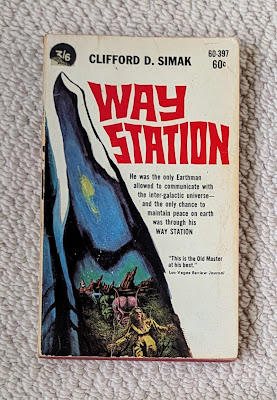
(I picked up this copy in a second-hand bookshop somewhere. I am sure I originally read the Methuen paperback with Chris Moore starships (which didn’t suit the story), but I guess I lost that. Instead I have this 1969 US edition with a baffling cover and “80p” scribbled in pencil on the inside cover.)
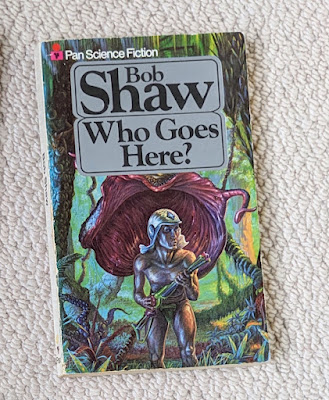
Oh my, this hasn’t aged well. Bob Shaw was one of the great SF writers of the 70s and 80s, and is probably most famous for 1974’s Orbitsville, which won the British Science Fiction Award for best novel.
He was also a mainstay of the convention scene, with his hilarious SF talks (I managed to see him once at the Brighton Worldcon in 1987). Most of his short story collections contain at least one humorous story.
And Who Goes Here? is his humorous novel, which concerns Space Legion new recruit Warren Peace. Recruits to the Space Legion join the legion to forget – specifically, to have that part of their memories that they are trying to forget removed. And Warren Peace can’t remember anything.
Anyway, it has one good joke (Warren Peace), and I found the rest painful. Apparently there was a sequel in 1993, but I missed it.
My favourite Bob Shaw stories are Other Days, Other Eyes (about slow glass), A Wreath of Stars, and Orbitsville (before it became a trilogy). And I may find Orbitsville a disappointment when I re-read it.
As for Who Goes Here?, it’s destined for Oxfam.

I was a huge Alan Dean Foster fan in my teens and twenties. I discovered Bloodhype at the school bookshop when I was 12 or so and immediately fell in love with the Humanx Commonwealth, ADF’s mostly-optimistic future.
I picked up this copy of For Love of Mother-Not on a school exchange trip to California – around then it was getting harder to get ADF’s novels in the UK, and I started relying on Forbidden Planet.
For Love of Mother-Not holds up surprisingly well despite struggling with the writing itself (it’s not a punchy, modern style of writing); I kept wanting to read on. I don’t remember my younger self being critical of the writing style, but I’m more alert to it now.
But the ideas in For Love of Mother-Not reminded me why I loved ADF’s Humanx Commonwealth so much. It’s an evocative universe, with colourful worlds, interesting characters, immense creatures and wondrous technology: the Devilope, mudders, skimmers, needlers, duralloy and much more (including mysterious ancient technologies that I just loved, although this novel doesn’t have any of that).
I noted a few uncomfortable topics that are (mostly) glossed over, such as mindwipe and eugenics. And Flinx, the hero, has a lethal pet that occasionally kills – but only in self-defence, so that’s okay. It’s certainly something my younger self didn’t notice.
However, re-reading For Love of Mother-Not has whetted my appetite for more Humanx stories. I’m keeping it for now.
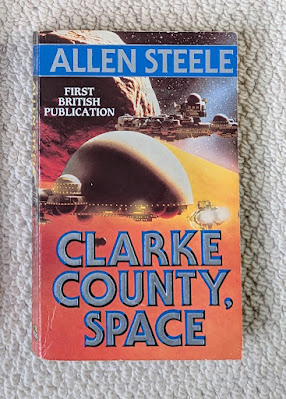
The newest book in this (short) list, and only a few pages in, I can tell it’s an easier read. Clarke County, Space is written in a more modern style and is more to my liking.
Set in 2050-ish, Clarke County, Space is set in the first artificial space colony orbiting Earth. It’s the second book in Steele’s “Near Space” series (the others are Orbital Decay, Lunar Descent, Labyrinth of Night, and A King of Infinite Space), which is an optimistic future where we embraced space travel in the 1990s. (So a similar vibe to For All Mankind – without being an alternate history.)
Anyway, Clarke County, Space is a thriller, with a small-town cop, a mob assassin, a mysterious hacker, Elvis Presley’s reincarnation, and a nuclear warhead. Everything is eventually resolved, if a bit messily and with a high body count.
Inevitably, something set in the near future feels more dated than the other novels. There are videotapes, diskettes – and, of course, no internet.
I imagine the Near Space series will be good inspiration for Mongoose’s upcoming Pioneer game. But if you’re going to do that, I would start with Lunar Descent, which is my favourite of the series.
Am I keeping it? No, I don’t think so. While I found it arguably better written than the other books here, there’s not enough in it for me to keep it.
Continue reading...
(I didn’t plan to read one novel from each decade, so that’s a happy coincidence. I even read them in chronological order – also a coincidence.)
Way Station by Clifford D Simak (1963)

Clifford D Simak is famous for his “pastoral SF” – gentle stories about decent people faced with alien mysteries. For me, Way Station is one of his finest.
Way Station is set in 1963 or so and concerns Enoch Wallace, a US Civil War veteran in charge of an alien “way station,” a stopover used by aliens travelling from one place to another. However, Wallace’s unusual longevity has attracted the attention of the US government…
In a modern-day story, attracting the government would be a bad thing – but in Simak’s world, the government merely watches. Wallace has done nothing wrong, so the government just watches. Except it turns out that they haven’t just watched Wallace; they’ve also dug up the mysterious grave (which contains an alien body), and that causes an interstellar crisis.
Anyway, the story also involves teleportation (Simak gets around the teleportation-is-murder problem by giving creatures a “soul”), alien maths that predicts nuclear war on Earth, “ghosts” that Enoch creates to keep himself company, an unruly neighbour who causes trouble, and Lucy with mysterious powers. It also ends on a deus ex machina, which is a shame.
I think there might be a freeform in there somewhere. I certainly like the idea of a game involving a way station, unsuspecting humans, and aliens. So I’m keeping it for now.
(I picked up this copy in a second-hand bookshop somewhere. I am sure I originally read the Methuen paperback with Chris Moore starships (which didn’t suit the story), but I guess I lost that. Instead I have this 1969 US edition with a baffling cover and “80p” scribbled in pencil on the inside cover.)
Who Goes Here? By Bob Shaw (1977)

Oh my, this hasn’t aged well. Bob Shaw was one of the great SF writers of the 70s and 80s, and is probably most famous for 1974’s Orbitsville, which won the British Science Fiction Award for best novel.
He was also a mainstay of the convention scene, with his hilarious SF talks (I managed to see him once at the Brighton Worldcon in 1987). Most of his short story collections contain at least one humorous story.
And Who Goes Here? is his humorous novel, which concerns Space Legion new recruit Warren Peace. Recruits to the Space Legion join the legion to forget – specifically, to have that part of their memories that they are trying to forget removed. And Warren Peace can’t remember anything.
Anyway, it has one good joke (Warren Peace), and I found the rest painful. Apparently there was a sequel in 1993, but I missed it.
My favourite Bob Shaw stories are Other Days, Other Eyes (about slow glass), A Wreath of Stars, and Orbitsville (before it became a trilogy). And I may find Orbitsville a disappointment when I re-read it.
As for Who Goes Here?, it’s destined for Oxfam.
For Love of Mother-Not by Alan Dean Foster (1983)
I was a huge Alan Dean Foster fan in my teens and twenties. I discovered Bloodhype at the school bookshop when I was 12 or so and immediately fell in love with the Humanx Commonwealth, ADF’s mostly-optimistic future.
I picked up this copy of For Love of Mother-Not on a school exchange trip to California – around then it was getting harder to get ADF’s novels in the UK, and I started relying on Forbidden Planet.
For Love of Mother-Not holds up surprisingly well despite struggling with the writing itself (it’s not a punchy, modern style of writing); I kept wanting to read on. I don’t remember my younger self being critical of the writing style, but I’m more alert to it now.
But the ideas in For Love of Mother-Not reminded me why I loved ADF’s Humanx Commonwealth so much. It’s an evocative universe, with colourful worlds, interesting characters, immense creatures and wondrous technology: the Devilope, mudders, skimmers, needlers, duralloy and much more (including mysterious ancient technologies that I just loved, although this novel doesn’t have any of that).
I noted a few uncomfortable topics that are (mostly) glossed over, such as mindwipe and eugenics. And Flinx, the hero, has a lethal pet that occasionally kills – but only in self-defence, so that’s okay. It’s certainly something my younger self didn’t notice.
However, re-reading For Love of Mother-Not has whetted my appetite for more Humanx stories. I’m keeping it for now.
Clarke County, Space by Allen Steele (1990)

The newest book in this (short) list, and only a few pages in, I can tell it’s an easier read. Clarke County, Space is written in a more modern style and is more to my liking.
Set in 2050-ish, Clarke County, Space is set in the first artificial space colony orbiting Earth. It’s the second book in Steele’s “Near Space” series (the others are Orbital Decay, Lunar Descent, Labyrinth of Night, and A King of Infinite Space), which is an optimistic future where we embraced space travel in the 1990s. (So a similar vibe to For All Mankind – without being an alternate history.)
Anyway, Clarke County, Space is a thriller, with a small-town cop, a mob assassin, a mysterious hacker, Elvis Presley’s reincarnation, and a nuclear warhead. Everything is eventually resolved, if a bit messily and with a high body count.
Inevitably, something set in the near future feels more dated than the other novels. There are videotapes, diskettes – and, of course, no internet.
I imagine the Near Space series will be good inspiration for Mongoose’s upcoming Pioneer game. But if you’re going to do that, I would start with Lunar Descent, which is my favourite of the series.
Am I keeping it? No, I don’t think so. While I found it arguably better written than the other books here, there’s not enough in it for me to keep it.
Continue reading...


